Wednesday, December 16, 2009

ECAD criminal provision omitted by Councilmember Laura Morrison


A summary published by the Austin City Council of the "Ordinances and Resolutions Sponsored or Co-Sponsored by Council Member Laura Morrison", omits any mention of the Energy Conservation and Disclosure ordinance's Class C misdemeanor penalty for non-compliance and a fine of up to $2000.
Here is the body of that text:

"Approve an ordinance adding a new Chapter 6-7 to the City Code relating to energy conservation audit and disclosure requirements, incorporating recommendations from the Energy Efficiency Retrofits Task Force, to become effective June 1, 2009. (Mayor Will Wynn, Council Member Lee Leffingwell and Council Member Laura Morrison)

Achieving energy efficiency savings in homes and buildings prior to the implementation of modern energy codes will have a significant impact oncommunity-wide energy use. These cost-effective energy efficiency improvements are proven to increase housing affordability and lower businessoperating costs. In December 2007, the City Council established the Energy Efficiency Retrofit Task Force to identify and recommend revisions to the city code to implement cost-effective energy efficiency retrofits and upgrades to Austin homes and buildings. This ordinance incorporates the recommendations of the task force by providing for an energy audit at the point of sale that would offer recommendations to home owners on voluntary upgrades. Additionally, the ordinance, among other things, initiates a process for pursuing energy efficiency upgrades for existing apartment buildings."

NOTE: The "Task Force" did not recommend a criminal provision for non-compliance, that stupid idea was the brainchild of Mayor Will Wynn and the property-rights trampling Austin City Council.

Sunday, December 13, 2009

The Austin Energy Conservation Disclosure Ordinance audit begins

If you sell your single-family home that is more than 10 years old in Austin, Texas and you purchase electricity from Austin Energy, a regulated monopoly, as of June 1st, 2009 you'll probably need to get an Energy Conservation Audit and Disclosure (ECAD), unless you have recently participated in an Austin Energy residential energy-efficiency program or meet one of the other varied exceptions. Similar requirements are in place for multifamily and commercial properties, but not condominiums or manufactured homes without a permanent foundation.

The audit includes an assessment of the R-value of the attic insulation, the percentage of air leakage through the HVAC duct system, the number of windows exposed to direct sunlight for at least an hour a day, and the energy-efficiency rating of the air-conditioning equipment. It also includes suggestions for improving the home’s energy efficiency. Mandatory audits are expected to cost $200 to $300 for a typical single-family home of 1,800 square feet or smaller with a single air-conditioning system. Auditors set their own prices, which depend on the size of the home.

Historical energy use for the home is not presented to the seller, nor is a report comparing the property's energy use to nearby properties.

There is no requirement to make improvements based on the audit - you just have to give the results to the person buying the house and a copy of the audit must be sent to to Austin Energy for their "records". If you're thinking of improving your home's energy efficiency, check Austin Energy's rebate programs. Good thing the Austin Board of REALTORS stood up to City Council, the City of Austin intended to mandate energy efficiency upgrades at the time a home was sold. Bend over and grab your wallet!

One final note, if you fail to get an audit, you'll be charged with a Class C misdemeanor and fined between $500 and $2000.

Austin Energy. It's just a monopoly.©

Saturday, December 12, 2009

My Energy Conservation Audit Disclosure letter to former Austin Mayor, Will Wynn

Chasingfun/Flickr

December 10th, 2009

Dear Mr. Wynn,

My name is John Barksdale and I'm an Austin homeowner.

In your June 11th, 2008 letter to the Austinist in which you reference the Energy Audit Ordinance, -which has evolved into the loathsome Energy Conservation Disclosure Audit (ECAD)-, you wrote,

"It WOULD require sellers to get an inexpensive energy audit and provide that information to prospective homebuyers."

Since you signed the mandatory ECAD into law, some details about the ordinance have changed since you penned your letter.

If an Austin homeowner fails to get an ECAD audit, a fine of up to $2000 for non-compliance and a Class C misdemeanor charge can be imposed. I guess you failed to mention the criminal charge in your letter? Also, the audit disclosure paperwork has to be submitted to Austin Energy so they can "keep it on file".

Austin Energy is a "community-owned" monopoly. As an Austin homeowner I can't take my money and buy electricity from a competing utility. Austin Energy sells me the electricity then browbeats me if I "use too much", or in your nanny-state jargon, "wasteful in their habits".

From your ABC News interview with Scott Mayerowitz on June 10, 2009, "Austin Forces Home Sellers to Pay for Energy Audits", "Wynn said the idea behind the ordinance was to encourage homeowners to upgrade their homes with more efficient air-conditioners, better windows and insulation. The original idea was just to require sellers to disclose their electric bills, but then he realized that some people are more wasteful in their habits than others. Hence, the home inspections."

I'm so pleased you decided to make yourself the arbiter of my labor, time and capital.

And the reason we have to "make expensive power purchases on the energy markets during the heat of summer" is because environmentalists like you make the construction of new power plants almost impossible. The French have a solution that produces electricity in a carbon-free manor; it's called nuclear power. Sadly, U.S. environmentalists demonized nuclear power in the 70's, so the utilities turned to cheap, abundant coal. Oh the environmental zealots of the 70's were so pleased with themselves! They had stopped the construction of new power plants in America, yet electricity utilities met consumer demands by contracting coal-burning plants. Well done environmentalists, pat yourself on the back.

Mr. Wynn, the amount of electricity I purchase and consume is my business, not yours or the business of the City of Austin.

Why am I so tough on you Mr. Wynn? Because you could have stood up for homeowner's liberty and property rights with a veto of the mandatory audit and its Class C misdemeanor.

Because you think you have the right to tell me what to do with my time, labor and capital, then I think I too have that right. Sir, how do you propose to pay for the ECAD audit of my Austin home?

After all, you did say it was inexpensive.


Regards,

John Barksdale
http://stoptheaustinecad.blogspot.com

Friday, December 11, 2009

Austin Energy Conservation Audit Disclosure Ordinance Claims First Victim

On the 6th of August, 2009, Paul Norris appeared before the Austin City Council. Mr. Norris submitted a personal letter, two emails and one photocopy of the Travis County Appraisal District tax assessment of his newly inherited property to the council and explained his concern.

Paul read his letter to the Council:

"Hello, mayor and members of the council. I'm here today to talk about some limitations to the ECAD ordinance, and I passed out some printed material and backup to that and I'm just pretty much going to read what I have here. I find myself in a unique situation today and I need your help. My family members and I inherited an old house within the last year and now have a contract for sale pending. The house is in very poor condition. Travis County Appraisal District values the house at one dollar. And the insurance carrier has recently canceled the homeowners policy due to the condition. And those are exhibits 1 and 2 in the material that I passed out. Under the current energy conservation audit and disclosure ordinance, ECAD, we've required to get an energy audit prior to sale. According to the city's website, the estimated cost of an audit is from $200 to $300 for a typical single-family home, 1800 square feet or smaller with one air conditioning system, which fits this house. The ordinance has a very narrow variance provisions which require both the seller and buyer's cooperation. The buyers are unwilling to consent due to their own time frames. The buyers have a nine-page inspection report which thoroughly addresses the house's energy issues. Existing code compliance will take care of the energy concerns when they finally get around to their remodel. Although I don't have any position on the ordinance one way or the other, I'm all for the environment. I've been recycling for 40 years, am a charter board member and founding sponsor of Keep Austin Beautiful and a formed the ecology action board member. Initially when I contacted city staff, they figured that the director could grant a variance, grant a waiver. However, city attorney Andy Purney says there is no provision for any other variance other than the one that's in the ordinance, which is either for a remodel or a demolition. There's two versions of it, within a six-month period after the sale transacts. I suggest the ordinance is poor. I suggest you all figure out how I can avoid the requirement in this case. Spending $200 to $300 on a house valued at one dollar in the midst of a recession doesn't make any sense. I don't believe that's the intention of this ordinance. Thank you."

Mayor Lee Leffingwell: Thank you, Mr. Norris. Councilmember Laura Morrison. Might be a question for you, Mr. Norris.
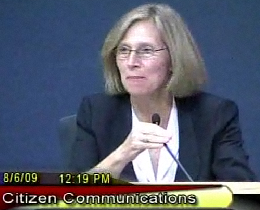

Council Member Laura Morrison: Actually if we have an attorney that --

Mayor Lee Leffingwell: We do.

Council Member Laura Morrison: That would be great. Could you talk a little bit about the waiver that goes into play if there's a demolition within six months in the future? How does that actually work?

Andy Perny: I am Andy Perny, Austin Energy legal services. He's correct, essentially there's two variance possibilities. There's actually a third related to undo hardship but that relates more to part of the ordinance that actually requires energy efficiency upgrades, not the audit portion. But essentially in order to qualify for the variance, both the buyer and seller would have to submit a variance application that they would agree to file the demolition permit within six months of the sale. That's just the plain wording of the ordinance.

Council Member Laura Morrison: I see. And that's not your situation here. Your buyer doesn't intend --

Paul Norris: The buyer is going to remodel it. There's two versions, the demolition and the remodel version. They are going to remodel it, but they are currently remodeling another property and are tied up on that project. There's an e-mail in here where their real estate agent is saying no, they are not going to enter into an agreement because of their own time frames.

Council Member Laura Morrison: and the remodel variance -- how does that actually work? It's required for that? Because it seems aparented someone is going to remodel it.
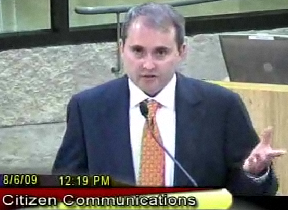

Andy Perny: I think there might be confusion because it was my understanding we were dealing with a demolition situation. The remodel situation is different. It doesn't contain a six-month gap. It simply states that the purchaser and seller have to agree to the remodel within a specified period of time.

Paul Norris: Well, when I had spoken to Steve Eanes and I clearly told him, he just got confused we originally --

Mayor Lee Leffingwell: Excuse me. This is not a colloquy here. We'll let the attorney speak and if there's another question for you.

Council Member Laura Morrison: Really maybe it sounds like a little more discussion is in order to clarify a few things. I wonder if you could take this off line and see if we can find a solution.


Thank you.


A gentleman comes comes before the Austin City Council to ask the Council to exempt him from the insidious, private-property rights violating ECAD. For his trouble Mr. Norris is scolded by the Mayor, bamboozled by the Austin Energy lawyer and swept aside by Councilmember Morrison.


By the way, do you know why the City Council had to get an Austin Energy attorney to answer a question about a single-home energy audit? The Energy Conservation Audit Disclosure was written with considerable input from Austin Energy's very own Andy Perny.


If you're wondering what became of Mr. Norris' plea...


Watch the Austin City Council dismiss Mr. Norris here.

Download Mr. Norris' supporting documentation here.

Thursday, December 10, 2009

New York City property owners stop costly mandatory energy audits

Congratulations to New York City property owners for exercising their private property rights!

They stopped a nanny-state, property-rights violating, chicken-little, carbon-phobia, law that mandated energy efficiency upgrades uncovered during a new mandatory energy audit.

Give the City of New York time and the upgrades will be mandatory in a year or two!

You didn't fight the mandatory audit, so the City of New York has one foot in the door of your property!

These provisions are just as stupid as the now mandatory Energy Conservation Audit Disclosure that Austin Texas home and business property owners were saddled with in 2009.

Some 22,000 buildings would have been affected by Mayor Bloomberg's statist mandatory audit initiative to raise the cost of operating buildings in New York City. According to the New York Times article, buildings account for 80 percent of total carbon (a harmless trace gas in the atmosphere) emissions. The cumulative building improvements would have cost $2.5 billion and the city only had about $16 million of federal stimulus money for loans. Well done Real Estate Board of New York!

In an April 22nd, 2009 press release from Mayor Bloomberg's office, his audit goals were spelled out under the "Audits and Retrofits Bill" heading:

"This legislation would require owners of existing buildings over 50,000 square feet to make cost-effective energy efficiency improvements to their buildings once every ten years by conducting an audit, retro-commissioning, and retrofitting their building. Buildings will undergo energy audits with results determining the necessary improvements to be undertaken, including insulating pipes, replacing inefficient lighting, and installing low-flow water fixtures. The legislation requires spending by building owners for only those retrofits that will pay for themselves in less than 5 years through energy-related cost-savings. Many of the required measures are low- to no-cost. Those savings will then continue beyond recovery of initial outlays. This bill would apply to all classes of buildings over 50,000 square feet, both private and City-owned, and will cover nearly half of the built square footage of New York City."

I had to research a differnet article to discover the burden property owners would have had to pay; unlike the New York Times article which was spellbound by the amount the government would pay or subsidize.

From the National Real Estate Investor, "Mayor Bloomberg Pushes Energy-Efficient Legislation for New York", May 5, 2009, by Sibley Fleming:

• legislation that creates a New York City Energy Code that existing buildings will have to meet whenever they undergo renovations.

• legislation that requires owners of buildings that are 50,000 sq. ft. or larger to conduct an energy audit once every 10 years and make any improvements that can be paid for within five years.

• legislation calling for buildings of 50,000 sq. ft. or more to include energy-efficient lighting systems, which can be paid for through energy savings.

• legislation that requires owners of buildings 50,000 sq. ft. or more to conduct an annual benchmark analysis of energy consumption. By doing so, building owners can better understand what steps they need to take to increase efficiency.

"Despite existing rebates and incentives from the New York State Energy Research and Development Authority, Con Edison as well as potential stimulus financing, Leslie Lisser (senior asset manager) of FirstService Williams notes that upfront retrofit costs could create stress for smaller building owners. “It costs a lot of money to go in and initially do an audit,” says Lisser. “It could cost $5,000 to $10,000, so in the case of a smaller building that money could be problematic.” "

Well done New York City property owners, well done!

Tuesday, December 8, 2009

The terrible Energy Conservation and Disclosure Ordinance

I thought it would be interesting to post the Austin City Council Energy Conservation and Disclosure ordinance that I thoroughly despise; so boldy and proudly proclaiming its penalty for non-compliance...


ORDINANCE NO. 20081106-047

AN ORDINANCE ADDING A NEW CHAPTER 6-7 TO THE CITY CODE RELATING TO ENERGY CONSERVATION AUDIT AND DISCLOSURE REQUIREMENTS; CREATING AN OFFENSE AND IMPOSING PENALTIES UP TO $2,000 FOR EACH OFFENSE. BE IT ORDAINED BY THE CITY COUNCIL OF THE CITY OF AUSTIN:

PART 1. The City Code is amended to add a new Chapter 6-7 to read: CHAPTER 6-7. ENERGY CONSERVATION. ARTICLE 1.

General Provisions. §6-7-1 DEFINITIONS.

In this chapter:
(1) COMMERCIAL FACILITY means a non-residential, civic, or commercial building and does not include an industrial building.
(2) DIRECTOR means the director of the Austin Electric Utility.
(3) MULTI-FAMILY FACILITY means a site with five or more dwelling units.
(4) OWNER means a person with a freehold interest in a facility to which this chapter applies.
(5) RESIDENTIAL FACILITY means a site with four or fewer dwelling units.
(6) TIME OF SALE means the date of the recording of a deed transferring legal title to real property to implement the sale of property.

§ 6-7-2 APPLICABILITY.
This chapter applies to a commercial, residential, or multi-family facility if the facility receives electric service from the Austin Electric Utility, as determined by the director.

§ 6-7-3 ADMINISTRATIVE RULES.
(A) The director shall adopt administrative rules for the implementation of this chapter.
(B) The rules shall be available for inspection at the Austin Electric Utility administrative offices during normal business hours.

§6-7-4 VARIANCES.
(A) The director may grant a variance from a requirement of this chapter if the director determines that, due to special circumstances unique to the applicant's facility and not based on a condition caused by actions of the applicant, strict compliance with provisions of this chapter would cause undue hardship. A variance granted under this subsection
(A) must be limited to the minimum change necessary to avoid the undue hardship.
(B) In addition to the variance authorized in subsection
(A), the director may grant a variance from a requirement in this chapter if the director determines that:
(1) application for a permit to substantially remodel or demolish the facility will be filed not later than 6 months after the time of sale; and
(2) in the case of remodel, the owner and the purchaser of the facility have entered into a binding agreement, in a form approved by the director, whereby the purchaser of the facility agrees to complete an energy audit within a specified period of time after remodel of the facility is complete.
(C) In addition to the variance authorized in subsection (A), the director may grant a variance from the requirements of Article 4 Commercial Facilities if the director determines that the facility is a data center or other high energy use facility that cannot be adequately evaluated using currently available audit or rating tools.
(D) A person may seek a variance by filing an application with the director. The director may require the applicant to provide information the director determines is necessary to evaluate the variance request.

§ 6-7-5 ENERGY AUDIT REQUIREMENTS.
(A) A residential or multi-family energy audit required under this chapter must:
(1) be conducted by a person certified as a building performance analyst or equivalent by an agency approved by the director; and
(2) use the audit and disclosure forms prescribed by rule under Section
6-7-3.
(B) A residential energy audit required under this chapter will meet the energy audit requirement of this chapter for a period often years after the audit is initially performed.
Article 2. Residential Facilities.

§ 6-7-11 Residential Energy Audit.
The owner of a residential facility must, before the time of sale of the facility, have an energy audit of the facility completed.

§ 6-7-12 Disclosure Required.
The owner of a residential facility must provide a copy of the energy audit required under this article to the purchaser or prospective purchaser of the facility before the time of sale and the person performing the audit must provide a copy of the energy audit to the director not later than 30 days after the audit is complete.

§ 6-7-13 Exemptions.
(A) This article does not apply to transfers of title to real property in the following circumstances:
(1) through a foreclosure sale or trustee's sale, or a deed in lieu of foreclosure;
(2) through a pre-foreclosure sale where the seller has reached an agreement with the mortgage holder to sell the facility for an amount less than the amount owed on the mortgage;
(3) through the exercise of or under the threat of eminent domain;
(4) from one family member to another family member without consideration;
(5) under a court order or probate proceedings; or
(6) under a decree of legal separation or dissolution of marriage, or property settlement agreement incidental to such a decree.
(B) This article does not apply to a residential facility if one or more of the following apply:
(1) the facility was constructed no more than ten years before the time of sale;
(2) the facility participated in the Austin Energy Home Performance with Energy Star program, or an equivalent Austin Electric Utility program, not more than ten years before the time of sale and either:
(a) performed at least three of the efficiency measures, or
(b) received a rebate of an amount prescribed by rule, but not less than five hundred dollars ($500.00);
(3) the facility participated in the Austin Energy Free Weatherization Program, or an equivalent Austin Electric Utility program, not more than ten years before the time of sale;
(4) the purchaser of the facility qualifies for and has signed an agreement, in a form acceptable to the director, agreeing to participate in the Austin Energy Free Weatherization Program or an equivalent Austin Electric Utility program, not later than six months after the time of sale; or
(5) the facility is manufactured housing built on a permanent chassis and designed to be used without a permanent foundation.
Article 3. Multi-Family Facilities.

§ 6-7-21 Multi-Family Energy Audit.
(A) The owner of a multi-family facility which is at least ten years old on June 1, 2009 must have an energy audit of the facility performed not later than June 1, 2011.
(B) The owner of a multi-family facility not required to perform an energy audit under subsection (A) must have an energy audit of the facility performed not later than 10 years after construction of the facility is complete.

§ 6-7-22 Disclosure Required.
The owner of a multi-family facility must post and provide to current and prospective tenants the results of the energy audit required under this article. The results must be on a form and in locations prescribed by rule. In addition, the owner must provide a copy of the required audit to the director not later than 30 days after the audit is complete.

§6-7-23 High Energy Use Facilities.
(A) Regardless of the date of construction of the facility, the director shall issue a notice to the owner of a multi-family facility that the director determines has an average per-square-foot energy usage exceeding 150% of the average for multi-family facilities within the Austin Electric Utility service area.
(B) An owner who receives a notice issued under subsection (A) shall implement energy efficiency improvements to the facility sufficient to bring the facility to within 110% of the average per-square-foot energy usage of multi-family facilities within the City not later than eighteen months after receipt of the notice.
(C) An owner required to implement improvements under this section may apply to the director for additional time to complete the improvements, but must file the application not later than 90 days after receipt of the notice. If the director determines that more than eighteen months is required to complete the improvements, the owner may execute a contract in a form acceptable to the director whereby the improvements required under this section will be completed within a period of time determined by the director.

§ 6-7-24 Exemptions.
This article does not apply to a multi-family facility if:
(1) the owner completed comprehensive duct remediation work on the facility though participation in an Austin Electric Utility rebate program no more than ten years before June 1, 2009;
(2) HVAC equipment was replaced through an Austin Electric Utility rebate program in all units of the facility no more than ten years before June 1, 2009;or
(3) HVAC equipment was replaced with equipment meeting the requirements for an Austin Electric Utility rebate program, though not participating in the program, in all units of the facility no more than ten years before June 1, 2009.
Article 4. Commercial Facilities.

§ 6-7-31 Commercial Facility Rating.
(A) The owner of a commercial facility that is at least ten years old on June 1, 2009 must calculate an energy use rating for the facility not later than June 1, 2011, using an audit or rating system approved by the director.
(B) The owner of a commercial facility not required to calculate an energy use rating for the facility under subsection (A) must calculate an energy use rating for the facility not later than 10 years after construction of the facility is complete, using an audit or rating system approved by the director.

§ 6-7-32 Disclosure Required.
The owner of a commercial facility must make a copy of the energy rating calculation required under this article available to a purchaser or prospective purchaser of the facility before the time of sale and must provide a copy to the director not later than 30 days after the audit is complete.
Article 5. Enforcement.

§ 6-4-41 Presumption of Violation.
The record owner of property is presumed to be responsible for a violation of this chapter that occurs at a facility on the property.

§ 6-4-42 Penalty.
(A) A person commits a criminal offense if the person performs an act prohibited by this chapter or fails to perform an act required by this chapter. Each instance of a violation of this chapter is a separate offense.
(B) Each offense under this chapter is subject to a fine.
1I) Proof of culpable mental state is not required for a fine of up to $500.
(2) If the person acts with criminal negligence, a fine of up to $2,000.00 may be assessed.
(C) Proof of a higher degree of culpability than criminal negligence constitutes proof of criminal negligence.
(D) Prosecution of an offense and enforcement of other remedies under this chapter are cumulative.
PART 2. This ordinance takes effect on June 1, 2009.

PASSED AND APPROVED

November 6, 2008 § Will Wynn Mayor


APPROVED: David Allan Smith, City Attorney

ATTEST: Shirley A. Gentry, City Clerk

Sunday, December 6, 2009

Sealing HVAC ducts and adding insulation won't help

The following letter is a reply I submitted to the Statesman.com article titled "Austin Climate Protection Program tries to ramp up its work, Jake Stewart, former soldier, sees the work as a security issue".

"The program aims to reduce carbon emissions, which scientists link to global warming..." is an editorial and can not go unchallenged as a "fact" Asher. The recent fallout of the Climate Research Unit in the UK (ClimateGate) is vivid proof that climate scientists have yet to form a consensus on the link, if any, between CO2 and temperature. This Climate Protection Plan is having some draconian side effects for Austin homeowners. The Austin Energy Conservation and Disclosure Ordinance mandates an energy audit for homeowners at the point of sale. However, if the abode is a mobile home without a foundation, a condominium, or a home less than 10 years old, those homeowners can use 10,000 kilowatt hours of electricity a month and be exempt from the ECAD. Non-compliance of this ordinance is a Class C misdemeanor and up to a $2000 fine. To add insult to injury, Mr. Stewart, you work for a public utility, -a monopoly. If I wished to buy electricity from another provider as an Austinite, I can't. Austin Energy sells me their product as a monopoly, then tells me how I must use it. Lee Leffingwell and Brewster McCracken, either of you can send me a check for $300, that should cover the cost of a mandatory energy audit for my home. It's your "great" idea, so you pay for it. Sealing some HVAC ducts in a single-family home and adding more insulation will not abate the need to build more power plants. Solar panels don't produce electricity at night and solar generates very little electricity under a cloudy sky. Austin's hand-wringing over a harmless trace gas in the atmosphere is laughable and a serious misallocation of capital and resources.

John Barksdale
http://stoptheaustinecad.blogspot.com/
identitythefthurts@gmail(dot)com